
For many, Obsessive-Compulsive Disorder (OCD) is often misunderstood as a minor personality trait or a simple drive for cleanliness. However, for those living with the condition, it is an exhausting, 24/7 battle against the brain’s own alarm system. When someone begins to experience intrusive thoughts, the natural instinct is to wait it out and hope that the anxiety will simply fade with time.
Unfortunately, clinical data and neurobiology suggest the opposite. OCD is not a condition that typically resolves on its own. Left unaddressed, it functions like a self-reinforcing loop, growing more entrenched as the brain optimizes its pathways for anxiety. At Ignite Counseling Colorado, we believe that understanding the trajectory of untreated OCD is the first step toward reclaiming your life.
In this blog, we will examine the physiological and psychological consequences of leaving the OCD cycle unchecked and why early intervention is the key to long-term functional freedom.
What Is OCD and How Does It Function in the Brain?
OCD is a chronic psychiatric disorder where intrusive, distressing thoughts called obsessions trigger repetitive physical or mental acts known as compulsions performed to neutralize the distress.
To understand why OCD worsens without treatment, we must first look at the biological framework behind it. OCD is not a lack of willpower; it is a breakdown in the brain’s communication system, specifically within the cortico-striato-thalamo-cortical (CSTC) circuit. These are deconstructed as:
- Obsessions: These are involuntary, intrusive thoughts, images, or urges. They are ego-dystonic, meaning they often go against the person’s actual values, which is why they cause such significant anxiety.
- Compulsions: These are behaviors, such as cleaning, checking, counting, or mental reviewing, used to reduce the anxiety caused by the obsession. While they provide temporary relief, they actually reinforce the brain’s belief that the threat was real and that the ritual was the only thing that saved the person.
The Neurobiology of the Worry Circuit
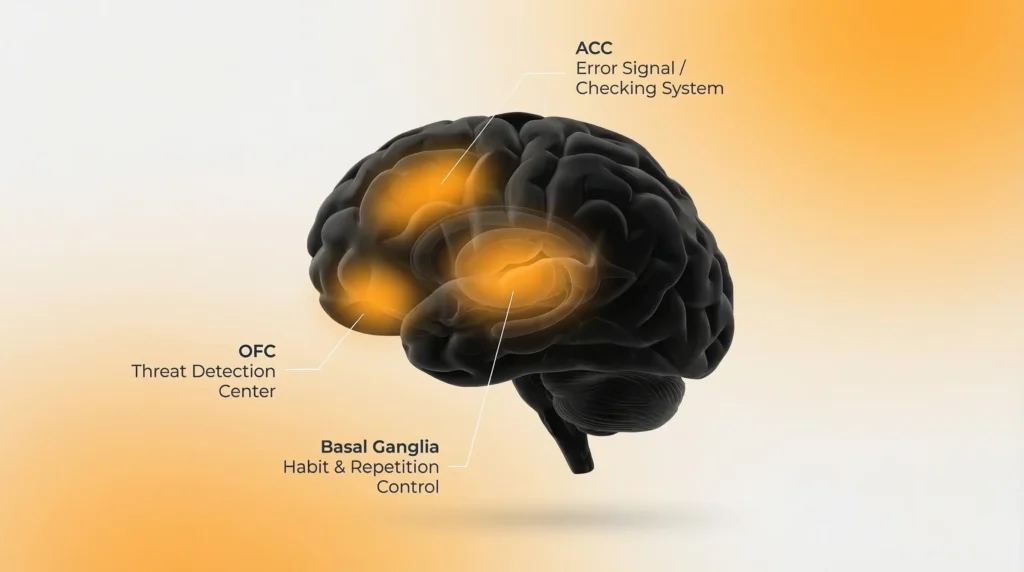
Research identifies three specific brain regions that become hyperactive in untreated OCD:
- Orbitofrontal Cortex (OFC): This is the threat detection center. In OCD, the OFC is overactive, constantly sending signals that something is wrong or dangerous.
- Basal Ganglia: This region is responsible for habit formation and motor pattern execution. It becomes locked into the compulsions’ repetitive nature.
- Anterior Cingulate Cortex (ACC): This serves as the error-signaling center. In a brain suffering from OCD, the ACC is constantly firing a mistake signal, creating that nagging feeling that a task isn’t quite finished or a ritual wasn’t done just right.
Furthermore, serotonin dysregulation plays a major role. Serotonin is the neurotransmitter responsible for communication between these regions. When serotonin levels are imbalanced, the brain cannot effectively break the intrusive thoughts, leading to a chronic cycle.
Does OCD Worsen Over Time Without Treatment?
Yes. Untreated OCD often increases in severity and frequency because the brain’s neuroplasticity strengthens compulsive circuits.
OCD rarely remains static. Because the brain is a learning machine, it gets better at whatever it practices. Every time you perform a compulsion to escape anxiety, you are teaching your brain that the compulsion is necessary for survival. This is known as the habit reinforcement loop.
Through neuroplasticity, the neural pathways associated with these rituals become physically stronger and more efficient. Over time, triggers that used to be minor start to feel catastrophic, and the safety provided by compulsions lasts for shorter and shorter durations.
While some individuals experience an episodic course with symptoms that wax and wane, the majority of untreated adults experience a chronic, progressive course. Stress acts as a massive amplifier. Major life transitions, such as starting a new job or the loss of a family member, can cause symptoms to skyrocket.
Mental Health Conditions That Develop Alongside Untreated OCD
Untreated OCD significantly increases the risk of developing secondary conditions like major depression, generalized anxiety, and suicidal ideation.
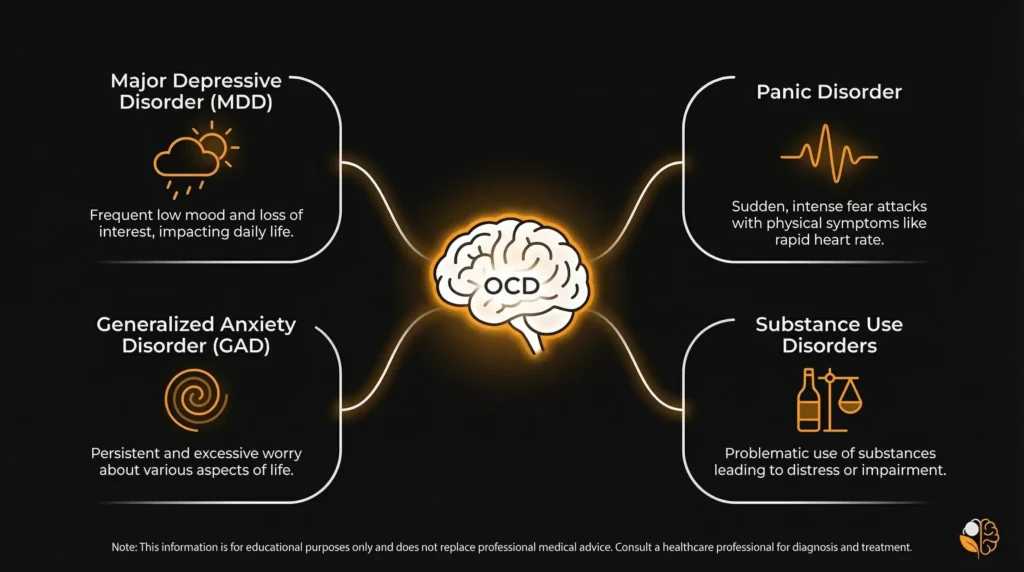
OCD rarely exists in a vacuum. The sheer exhaustion of living with constant intrusive thoughts often leads to comorbidity, which is the presence of two or more disorders. According to the DSM-5, up to 90% of people with OCD will meet the criteria for at least one other psychiatric disorder in their lifetime.
- Major Depressive Disorder (MDD): This is the most common comorbid condition. The persistent hopelessness and the loss of time due to rituals often lead to a secondary depression. Sufferers feel exhausted by the lack of control over their own minds.
- Generalized Anxiety Disorder (GAD): The hyper-vigilance required by OCD often spills over into chronic worry about everyday life events.
- Panic Disorder: When the spikes of OCD become too intense, they can trigger full-blown panic attacks.
- Substance Use Disorders: Many individuals attempt to numb the intrusive thoughts or the physiological spike of anxiety through alcohol or drugs, leading to addiction.
- Suicidal Ideation: It is a tragic misconception that OCD is just about checking stoves. Severe OCD is associated with significantly elevated risks of suicidal ideation and attempts due to the intense mental suffering involved.
How Does Untreated OCD Affect Work, School, and Relationships?
Untreated OCD reduces overall productivity, creates academic barriers, and places immense strain on interpersonal relationships.
The functional impairment of OCD is measured by the hours lost to rituals and the avoidance behaviors used to stay away from triggers.
- Work and School: Concentration becomes nearly impossible when a mental loop is running in the background. Students may experience academic decline because they have to re-read sentences dozens of times or rewrite assignments until they are perfect. In the workplace, this manifests as delayed task completion and reduced performance.
- Relationships: OCD is often called a family disease. Many sufferers engage in reassurance-seeking, constantly asking loved ones if they are okay or if they did something bad. This creates frustration and conflict. Furthermore, the embarrassment of rituals often leads to social withdrawal and isolation.
OCD Causes Physical Health Problems
The chronic stress state associated with untreated OCD creates significant physiological wear and tear.
The body is not designed to be in a state of high alert for hours every day. When the brain perceives a threat, it floods the body with cortisol and adrenaline.
- Immune Suppression: Chronic elevation of cortisol weakens the immune system, making the individual more susceptible to illness.
- Sleep Disruption: Many people with OCD have rituals that must be completed before bed, or their intrusive thoughts keep them awake. This leads to chronic fatigue and cognitive decline.
- Physical Damage: Contamination-based OCD often leads to skin damage like dermatitis from excessive washing or harsh chemicals.
- Malnutrition: If OCD centers on food contamination or choking fears, it can lead to dangerous weight loss and nutritional deficiencies.
What Happens When OCD Is Left Untreated in Children and Teens
Untreated OCD can disrupt crucial developmental milestones and increase the risk of the disorder becoming a lifelong struggle.
In children, OCD does not just affect their mood; it affects their growth and learning.
- Academic Regression: A child who cannot stop counting or checking their backpack will fall behind their peers.
- Social Skill Delay: Children may avoid social play or birthday parties to hide their rituals, missing out on vital social learning.
- Family Accommodation: Parents often inadvertently help by participating in rituals like washing the child’s clothes a certain way. While well-intentioned, this reinforces the OCD and prevents the child from learning to tolerate discomfort.
- Lifelong Chronicity: Early-onset OCD that is not treated with evidence-based methods like ERP is more likely to persist into adulthood in a more severe form.
Can OCD Go Away Without Treatment
Spontaneous remission is exceptionally rare for OCD.
While some mental health struggles may resolve as a person’s life circumstances improve, OCD is fundamentally different because it is rooted in a self-perpetuating neurological loop. While symptoms may fluctuate in intensity and become milder during periods of low stress, they rarely disappear entirely.
Waiting for OCD to go away usually just gives the disorder more time to generalize to new areas of your life. The only evidence-based way to interrupt this cycle is through specialized treatment, specifically Cognitive Behavioral Therapy with Exposure and Response Prevention (ERP) and, in many cases, medication like SSRIs to stabilize the brain’s neurochemistry.
What Are the Long-Term Risks of Untreated OCD
The long-term risk of untreated OCD is chronic disability and a significant reduction in quality of life metrics.
The longer OCD remains untreated, the more treatment-resistant it can become. The neural pathways become so deeply grooved that it takes more intensive work to overwrite them.
The Risk Escalation Model:
- Intrusive thoughts intensify: They become more frequent and more graphic.
- Compulsions expand: Rituals that used to take 5 minutes now take 50 minutes.
- Avoidance behaviors generalize: You start avoiding more places, people, and activities.
- Social isolation increases: The world becomes very small as the disorder dictates your movements.
- Depression risk rises: The weight of the disorder becomes a primary driver of despair.
When Should Someone Seek Professional Help
You should seek professional help if OCD-related thoughts or behaviors consume more than one hour per day or impair your daily functioning.
The DSM-5 diagnostic threshold for clinical OCD is rituals or thoughts that consume at least one hour of your day, but you do not have to wait until you hit that mark to seek help.
Red Flags to Look For:
- You feel trapped by your thoughts.
- You find yourself asking others for reassurance multiple times a day.
- You avoid specific places or activities because of what-if thoughts.
Emergency Sign: If you are experiencing suicidal ideation or thoughts of self-harm, seek immediate help.
The Path Forward
Always remember, OCD is highly treatable. If you recognize these patterns in yourself or a loved one, as we mentioned above, do not wait for the cycle to worsen. Reclaiming your time, your health, and your relationships is possible. Most people begin to feel the benefits of recovery within just a few months of specialized treatment.
At Ignite Counseling Colorado, we specialize in Exposure and Response Prevention (ERP), the gold standard of care. ERP does not just talk about the problem; it trains your brain to handle uncertainty and lowers the volume on those intrusive thoughts.
If you are in Colorado, contact us today to beginbreaking the cycle and finding functional freedom. Our offices are conveniently located in Westminster, Denver, and Longmont.