Have you ever shared something deeply personal with someone, only to realize afterward that you may have overwhelmed them? Or has someone opened up to you about painful experiences, leaving you emotionally drained and unsure how to respond?
These situations can be examples of trauma dumping, a pattern of sharing deeply distressing experiences without considering the other person’s emotional capacity, boundaries, or willingness to listen.
Trauma dumping isn’t a mental health diagnosis, nor does it mean you’re wrong for talking about painful experiences. However, understanding the difference between healthy sharing and trauma dumping can help you build stronger relationships and find healthier ways to process difficult emotions.
In this article, we’ll explore what trauma dumping means, the signs to recognize in yourself or others, how it differs from healthy venting, and practical ways to communicate while respecting emotional boundaries.
What Is Trauma Dumping?
Trauma dumping is the act of sharing deeply distressing or traumatic experiences with someone without considering whether they are emotionally prepared or willing to listen. It often involves sharing intense personal details unexpectedly, leaving the other person feeling overwhelmed or emotionally drained.
Unlike healthy conversations, trauma dumping can become one-sided, with little room for the listener to express their feelings or set boundaries. It may happen with friends, family members, romantic partners, coworkers, or even people you barely know.
Trauma dumping isn’t a clinical diagnosis or necessarily an intentional behavior. People may do it because they are struggling with unresolved trauma, feel emotionally overwhelmed, lack a reliable support system, or simply don’t know how to process what they’ve experienced.
Sharing painful experiences isn’t inherently unhealthy. Opening up to others can help you feel supported and understood. The concern arises when the sharing happens without mutual consent, disregards emotional boundaries, or becomes the primary way someone manages their distress.
Understanding this distinction can help you recognize when opening up is healthy and when it may be time to explore other ways of processing difficult experiences.
Trauma Dumping vs. Healthy Venting: What’s the Difference?
Sharing difficult experiences with others can be a healthy way to process emotions, reduce stress, and feel supported. However, not every conversation about painful experiences is trauma dumping. The difference often comes down to consent, mutual participation, and respect for emotional boundaries.
According to Dr. Kia-Rai Prewitt, PhD, a psychologist at Cleveland Clinic, venting allows people to share frustrations with someone they trust, often with mutual validation and an opportunity to work through the problem. Trauma dumping, on the other hand, can leave the listener feeling overwhelmed and unable to participate in the conversation.
Here’s how the two compare:
| Healthy Venting | Trauma Dumping |
|---|---|
| Asks whether the other person has time to listen. | Shares distressing experiences without checking first. |
| Allows both people to express their feelings. | Often becomes one-sided, leaving little room for the listener. |
| Respects the other person’s emotional boundaries. | May overlook the listener’s emotional capacity. |
| Focuses on expressing feelings and finding perspective. | May involve repeatedly sharing distress without working toward processing it. |
| Remains open to feedback and possible solutions. | May repeatedly reject feedback or attempts to find solutions. |
| Usually has reasonable limits around time and topics. | Can continue for extended periods or jump between distressing topics. |
The important distinction is that sharing painful experiences isn’t inherently unhealthy. You should be able to talk about difficult moments and seek support from people you trust. However, healthy sharing also means recognizing that other people have their own emotional needs and boundaries.
Learning to recognize this difference can help you build stronger relationships while finding healthier ways to process difficult emotions.
6 Signs of Trauma Dumping (in Yourself and Others)
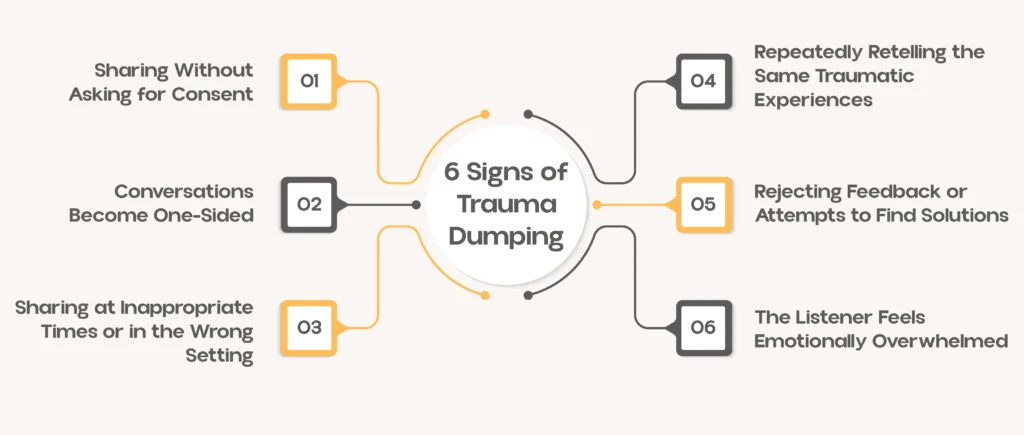
Trauma dumping isn’t always easy to recognize, especially when someone is simply trying to express painful emotions or seek support. However, certain communication patterns can indicate that sharing has become overwhelming for the other person. Here are six signs to look for in yourself or someone else.
1. Sharing Without Asking for Consent
One common sign of trauma dumping is starting a conversation about deeply personal or distressing experiences without checking whether the other person is comfortable listening.
For example, you might begin discussing a painful childhood experience or a traumatic relationship while someone is having lunch, working, or dealing with their own problems.
Healthy communication involves asking first, such as, “Is now a good time to talk about something difficult?”
2. Conversations Become One-Sided
In a healthy conversation, both people have an opportunity to express themselves, ask questions, and share their feelings. Trauma dumping can make the interaction one-sided, with one person doing most of the talking.
The listener may struggle to contribute, change the subject, or explain how they feel because the conversation continually returns to the speaker’s distress.
3. Sharing at Inappropriate Times or in the Wrong Setting
The timing and setting of a conversation matter. Sharing deeply distressing experiences during a casual lunch, a workplace meeting, or a first date may leave the other person feeling uncomfortable or unprepared.
This doesn’t mean difficult conversations should only happen in private or formal settings. Instead, consider whether the situation is appropriate and whether the listener has the emotional space to engage.
4. Repeatedly Retelling the Same Traumatic Experiences
You may find yourself sharing the same painful memories with different people or repeatedly bringing up distressing experiences during unrelated conversations.
Talking about trauma more than once isn’t necessarily unhealthy. However, if you feel compelled to retell the same experiences without gaining relief or finding a way to process them, it may be worth exploring additional support.
5. Rejecting Feedback or Attempts to Find Solutions
Sometimes, people share difficult experiences because they want someone to listen, not because they need advice. That’s perfectly normal.
However, trauma dumping may become a recurring pattern when someone consistently dismisses the other person’s perspective, refuses to acknowledge their boundaries, or becomes upset when the conversation is redirected.
The issue isn’t rejecting advice itself. It’s whether the conversation allows room for mutual understanding and respect.
6. The Listener Feels Emotionally Overwhelmed
Another important sign is how the other person feels during and after the conversation. They may feel emotionally exhausted, helpless, anxious, or unsure how to respond.
If someone regularly leaves conversations feeling emotionally drained, it may indicate that their boundaries or emotional capacity aren’t being considered.
Why Is Trauma Dumping Harmful?
Talking about painful experiences can help people feel supported and understood. However, when someone repeatedly shares distressing experiences without considering the other person’s feelings or boundaries, it can create difficulties for both people. The listener may feel emotionally drained, while the person sharing may struggle to maintain healthy relationships or find more effective ways to process their emotions.
Effects on the Listener
Listening to someone else’s painful experiences can be difficult, especially when conversations include distressing details or happen unexpectedly. Over time, repeated exposure to another person’s trauma can leave listeners feeling overwhelmed, anxious, or emotionally exhausted.
A 2023 meta-analysis published in the International Journal of Listening, titled Can Listening Hurt You?, reviewed 49 studies and found that listening to other people’s traumatic experiences was associated with increased stress. Although this doesn’t mean every difficult conversation causes emotional harm, it highlights why respecting someone’s willingness and ability to listen matters.
Effects on the Person Sharing
Trauma dumping can also make relationships more difficult. When conversations repeatedly become one-sided, friends and family members may begin to withdraw because they feel overwhelmed or unsure how to respond. This can leave the person sharing feeling rejected, misunderstood, or increasingly isolated.
Another concern is that repeatedly talking about painful memories doesn’t always help someone work through them. They may continue experiencing the same difficult emotions without finding healthier ways to cope. Speaking with a trauma-informed therapist can offer a supportive space to understand these feelings, work through difficult experiences, and develop practical coping strategies.
The goal isn’t to stop talking about painful experiences or seeking support. It’s to find healthier ways to share what you’re going through while respecting your own needs and others’ emotional boundaries.
Healthier Ways to Share and Process Trauma
Sharing painful experiences is an important part of feeling supported and understood. The goal isn’t to keep your emotions to yourself but to find healthier ways to express them while respecting your own needs and the other person’s boundaries.
Whether you’re struggling to share your experiences or feeling overwhelmed by someone else’s, a few communication changes can make difficult conversations more comfortable for everyone.
If You’re Sharing Your Experiences
Before opening up about something painful, consider whether the other person has the time and emotional capacity to listen. A simple question like, “Is now a good time to talk about something that’s been bothering me?” gives them the opportunity to respond honestly.
It can also help to focus on how an experience has affected you rather than sharing every distressing detail. For example, instead of describing a painful event in detail, you might explain that you’ve been feeling anxious, struggling with trust, or having difficulty sleeping. This allows you to communicate your feelings without overwhelming the conversation.
Another helpful approach is to build a wider support system. Friends and family can offer comfort and understanding, but they don’t always have the knowledge or resources to help you process difficult experiences. Therapy, support groups, journaling, and other healthy outlets can give you additional ways to work through your emotions.
If Someone Is Sharing Their Experiences With You
Listening to someone you care about doesn’t mean you have to be available for every difficult conversation. It’s okay to recognize your emotional limits and communicate them respectfully.
If you’re not in the right headspace to listen, you could say, “I care about you, but I’m not in the best place to talk about something this heavy right now. Can we talk another time?”
You can also ask what kind of support they’re looking for. A simple question like, “Would you like me to listen, or are you looking for advice?” can help you understand their needs and avoid misunderstandings.
If someone regularly shares experiences that feel overwhelming, gently encourage them to consider professional support. You might say, “It sounds like you’ve been carrying a lot. Have you considered talking to a therapist who can help you work through this?”
When to Seek Professional Trauma Therapy
Sharing your experiences with trusted friends and family can provide comfort, but sometimes emotional support alone isn’t enough. If painful memories continue affecting your daily life, relationships, or ability to manage emotions, speaking with a mental health professional may help you find healthier ways to cope.
Consider seeking professional trauma therapy if:
- Memories continue affecting your daily life: You frequently think about distressing experiences or struggle to move forward.
- You feel emotionally overwhelmed: Anxiety, sadness, fear, or other difficult emotions interfere with your everyday activities.
- Your relationships are suffering: You find it difficult to communicate your feelings, maintain boundaries, or build healthy connections.
- You struggle with sleep or concentration: Distressing memories make it difficult to sleep, focus at work, or manage everyday responsibilities.
- You feel unable to process experiences on your own: You repeatedly revisit painful memories but struggle to understand or manage the emotions associated with them.
Trauma therapy provides a supportive environment where you can explore difficult experiences at a pace that feels manageable. A qualified therapist can help you understand your emotional responses, develop coping strategies, and feel more comfortable in your daily life.
If you’re in Colorado, Ignite Counseling Colorado offers support for individuals working through trauma and its effects. Through trauma-informed therapy, you can work with a mental health professional to better understand your experiences and find a path toward healing.
Final Thoughts
Talking about painful experiences is a natural part of seeking support and feeling understood. However, how you share those experiences matters. Trauma dumping can place emotional pressure on others and make relationships more difficult, but that doesn’t mean you should keep your feelings to yourself.
Learning to recognize the difference between healthy sharing and trauma dumping can help you communicate more openly, respect emotional boundaries, and build stronger relationships. If you’re struggling to process painful experiences or find that they continue affecting your daily life, professional support can help.
If you’re ready to take the next step, Ignite Counseling Colorado can help you explore your experiences in a supportive environment.