
For most of the summer, afternoons felt manageable. Then school started. Now your child drops their backpack by the door, snaps when you ask about their day, or goes to their room and shuts their door. You find yourself choosing every word carefully, unsure whether this is a rough return to school or a sign that something more is going on.
The first reaction does not answer that question. What matters is what happens next. Does your child settle once the day’s pressure is over? Does the stress follow them into homework, bedtime, or the next morning? Is the pattern easing, or is each school day getting harder?
So, what kind of support does your child need after school? In this guide, we will help you understand whether your child needs a gentler transition at home, support with a specific problem at school, or a professional assessment. By looking at how they recover, where the difficulty shows up, and whether it is getting easier or harder, you can begin to see which type of support fits.
Why Some Children Struggle After the School Day
Returning to school means adjusting to a very different rhythm from summer. Your child navigates lessons, social interactions, and expectations, all away from the familiarity of home. They may be dealing with friendship conflicts, feeling left out by classmates, or experiencing teasing or bullying. After spending the day managing these experiences, even a small request at home can feel like more than they have energy left to handle.
That can explain why a child who seemed fine at school struggles as soon as they are home. It does not mean they were pretending at school or choosing to behave differently with you. Home may simply be where you first see how much effort the day requires.
The first reaction matters less than what happens as the afternoon continues. If your child reconnects after food, quiet, movement, or company, the difficulty may be concentrated in the transition home. If the distress lasts through the evening or shifts into worry about the next day, the pattern reaches beyond that transition. How your child recovers is the first clue to the kind of support that may help.
When a Gentler After-School Routine May Be Enough
Home support may be enough when the difficulty stays close to the transition itself. Your child may be irritable or quiet at first, but they recover. Later, they can talk, complete at least some of their usual routine, and reconnect with the people or activities they care about.
In that situation, the goal is not to create a perfect after-school routine. It is to remove one source of pressure from the first part of the afternoon. Some children want food and silence. Others need movement, company, or a clear idea of when homework will begin. Choose the option that helps your child shift out of the school day without creating more conflict for the family.
You can shape the routine with your child by asking, “What would make coming home feel easier this week?” If that question is too broad, offer two realistic choices. You might ask whether they would rather have quiet time before homework or talk with you about their day over a snack.
Changing one thing at a time makes it easier to tell whether the routine is helping. If your child begins recovering more easily, that is useful information. If the same difficulty keeps returning around a particular day, class, assignment, or social situation, the transition home may not be the main problem. Something within the school day may need attention.
When The School Day Needs A Closer Look
A repeated after-school reaction often becomes easier to understand when you stop asking about the whole day. Wait until your child has settled, describe what you have noticed, and ask about the part that seems connected.
For example: “I’ve noticed that you seem more stressed after school lately. Has anything been happening in class or with your friends?” This gives your child a real starting point. It also shows that you are trying to understand the pattern, not catch them doing something wrong.
If they share a problem, you do not need to question every detail or solve it immediately. First, find out what they want from you: “That sounds like a lot to carry until you get home. Do you want me to just listen or help you think through it?” Their answer tells you whether they want space, problem-solving, or adult involvement.
Your child may not know what is wrong, and that uncertainty is information too. In that case, compare what you see at home with what a teacher or school counselor sees during class, lunch, transitions, and dismissal. Share the pattern without offering a diagnosis: “I’ve noticed my child seems upset after lunch and has been reluctant to come to school. Have you noticed anything that might be contributing to this?”
If the concern is tied to one part of school, a classroom change or school-based support may address it. If the distress is no longer limited to one part of the day, it is time to look beyond the immediate school problem.
When Counseling May Be Worth Considering
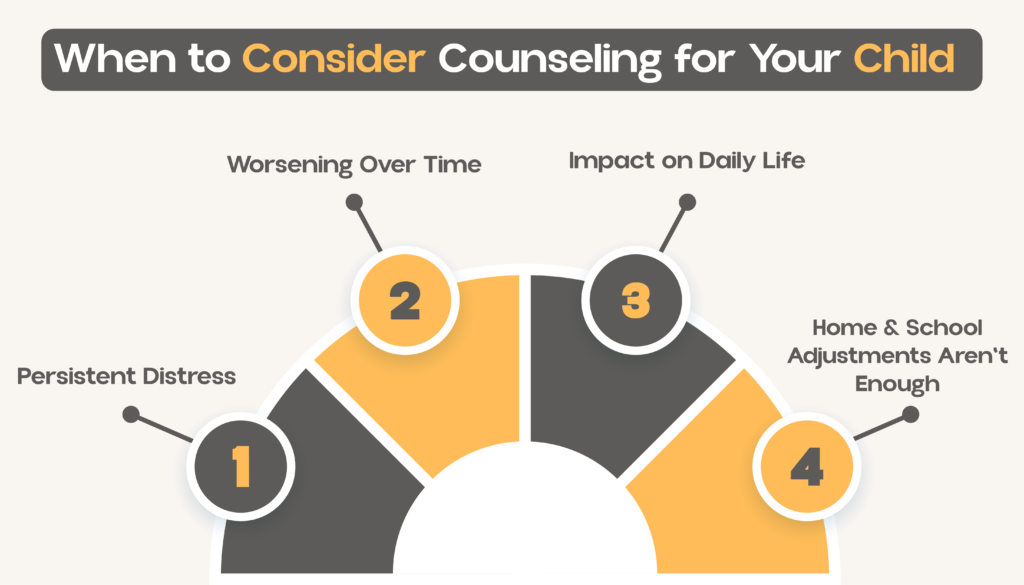
Counseling may be worth considering when the pattern is persistent, intensifying, or interfering with daily life. The question is not whether your child has an occasional difficult afternoon. It is whether they recover and continue to function in the parts of life that matter to them.
A wider assessment may be useful when:
- The distress continues through the evening or returns before school.
- The pattern is becoming harder rather than settling as the routine becomes familiar.
- Sleep, eating, attendance, schoolwork, friendships, or usual activities are changing.
- Reasonable adjustments at home and school have not been enough.
These signs do not identify a diagnosis. They show that the problem deserves more context than a parent or teacher can gather alone. Also discuss frequent, severe, or new physical symptoms with your child’s health care provider.
Mental health professionals as we have here at Ignite Counseling can look at the full pattern with you and your child. That includes what happens at school, how the afternoons unfold, what has changed, and what has already helped. The purpose is to understand the difficulty before deciding what kind of care, if any, fits.
Youth and Family Counseling for Children and Teens
If your child’s after-school struggles are becoming harder to manage or affecting daily life, professional support can help. Learn more about Youth and Family Counseling at Ignite Counseling Colorado and how our therapists can help children, teens, and families understand what is driving the difficulty.
So, Does Your Child Need Extra Support After School?
Use the pattern to make the decision:
- If your child recovers and the difficulty stays within the transition home. Simplify the first part of the afternoon and involve your child in choosing what helps.
- If the reaction keeps pointing to a class, assignment, peer situation, or school transition. Talk with your child and the school about that specific part of the day.
- If your child is not recovering, the difficulty is spreading, or daily life is being affected. Talk with a pediatrician or mental health professional about an assessment.
The Right Support Starts With The Right Question
When the backpack hits the floor tomorrow, you don’t have to decide everything in that moment. The question is not simply, “How do we stop these difficult afternoons?” It is, “What is this pattern asking for?” A smoother transition, a school conversation, and a professional assessment each respond to a different need.
If the pattern points toward counseling, Ignite Counseling Colorado offers child and teen therapy for families who want help understanding what is driving the difficulty. A consultation can help you decide whether Ignite or another resource makes sense for your child.