
People usually come to us with this question in mind, and almost always with a stopwatch in hand. They want a number. A few weeks, a few months, some finish line they can circle on a calendar so they know how much longer they have to feel like this.
The honest answer is that trauma does not heal on a clock. But that is not the discouraging news it sounds like, because the clock was never measuring the right thing.
Here is what we tell the people who come to us. The question is not really how long it will take for the pain to stop. It is how long until the trauma stops running the show. Those are two very different finish lines, and once you see the difference, the whole timeline starts to make sense.
Trauma Does Not Heal Like A Broken Bone
We borrow our idea of healing from the body. A bone breaks, you wait six weeks, the cast comes off, and time does the work for you. It feels reasonable to expect emotional healing to behave the same way.
But trauma is not stored like an ordinary memory that grows distant with time. When something overwhelms your system, your brain often files it wrong. Instead of being archived as something that happened, it stays loaded as something that is happening. That is why a sound, a smell, or a certain tone of voice can drop you straight back into the moment, heart pounding, as if no time has passed.
This is the part that changes everything. Time by itself does not heal trauma. The part of you that holds the memory still reacts as if the danger is happening right now, no matter how much time has actually passed. Healing is the slow work of teaching that part of you that the danger is over.
The Real Question Is Your Relationship To The Memory
A more useful way to measure healing is to stop watching the calendar and start watching your relationship to the memory.
Early on, the trauma is the loudest thing in the room. It interrupts your sleep, hijacks your focus, and decides what you can and cannot do. As healing progresses, the memory does not necessarily vanish. What changes is its volume and its authority over you. It moves from the front of your mind to the background and stops making your decisions for you.
So when people ask whether you can fully heal from trauma, the answer is yes, as long as we are precise about what healing means. It does not mean the event is erased. It means you can hold it without being held hostage by it. The scar remains. The wound closes.
The Arc Most People Navigate
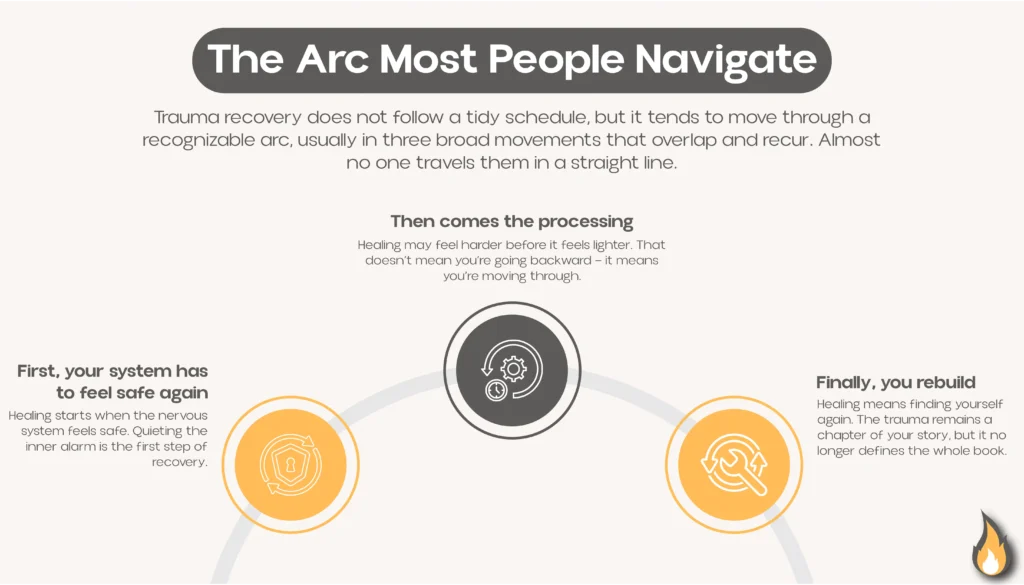
Trauma recovery does not follow a tidy schedule, but it tends to move through a recognizable arc, usually in three broad movements that overlap and recur. Almost no one travels them in a straight line.
First, your system has to feel safe again. Before you can process anything, the alarm has to quiet down. After trauma, the nervous system often stays stuck on high alert, scanning for threats that are no longer there. Nothing meaningful can be processed while the smoke alarm is still shrieking, so this is not a delay before the real work. It is the real work.
Then comes the processing. This is usually the hardest stretch, and where the biggest change happens. With enough stability beneath you, you begin to turn toward the experience rather than away from it. This stage often carries real grief, for what was lost or the time spent surviving rather than living. If you feel worse before you feel better here, that is not a wrong turn. It usually means the work is doing exactly what it should.
Finally, you rebuild. As the trauma loosens its grip, your attention turns outward again, toward relationships, identity, and a future you can actually picture. People often describe this stage as meeting themselves again. The trauma becomes a chapter in the story rather than the whole book.
You will likely cycle back through these more than once. A new stressor or a difficult anniversary can pull you back to the beginning, and that is not regression. It is how the process is built.
Why Some People Heal Faster Than Others
If two people can go through similar events and recover on very different timelines, it is worth understanding what actually moves the needle. It is almost never willpower. It is the conditions.
The nature of the trauma matters most. A single, contained event tends to resolve faster than trauma repeated over years, because repetition carves deeper grooves. Trauma that happened in childhood usually asks for more time, since it shaped you while you were still being formed. This is something we see often in the teens and young adults we work with at Ignite Counseling Colorado, where trauma can become tangled up with identity and development in ways that take patient, age-appropriate care to untangle.
What Therapy Actually Does To The Timeline
You can heal without therapy. Strong relationships, steady routines, and time genuinely help, and plenty of people find their way through on their own.
But trauma-focused therapy tends to make the road steadier and shorter, and it lowers the odds of symptoms lingering for years. A good trauma therapist is not there to hurry you. They are there to keep you safe enough to do the hardest parts without being overwhelmed, and to help your brain re-file what it could not file on its own.
Several approaches are well supported by research, including EMDR, which helps the brain reprocess stuck memories; Trauma-Focused Cognitive Behavioral Therapy, which works on the beliefs trauma leaves behind; and somatic methods that work through the body, where trauma is often held. The best fit depends on you and your history, and it is a decision you make together.
What therapy will not hand you is a guaranteed number of sessions with a date on the end. What it gives you instead is a guide for the parts of the path that are hardest to walk alone.
How To Tell You Are Healing, Even When It Does Not Feel It
Healing is rarely dramatic. There is usually no single morning you wake up cured. It tends to arrive quietly, in changes you only notice in hindsight.
A trigger that used to flatten you now passes through with less force. You string together more good days than hard ones. You catch yourself thinking about next month or next year, something that recently felt impossible. You react to the people you love from a calmer place. And the memory, when it surfaces, increasingly feels like something that happened to you rather than something happening to you.
You will not notice all of these at once, and you do not need to. Even one is real evidence that the ground is shifting in the right direction.
When It Is Time To Reach Out
Healing on your own is possible, but some signs suggest it is worth bringing in support: when the distress does not ease over time, when it interferes with your work, relationships, or daily life, when symptoms seem to be worsening, or when you find yourself withdrawing from the people and things that once mattered.
Reaching out is not an admission that you could not handle it. It is one of the most self-respecting things a person can do.
And if you are ever in crisis or thinking about harming yourself, please reach out immediately. You can call or text 988 to reach the Suicide and Crisis Lifeline, available around the clock. If you are in immediate danger, call 911.
The Part Worth Holding Onto
Healing from trauma is not only about returning to who you were before. Many people come through it carrying something they did not expect: deeper relationships, a sharper sense of what matters, and a steadiness they did not know they had.
That does not mean the trauma was worth it. It means you are capable of far more than survival.
Whatever stage you are in, the pain you are carrying today is not the final word on your life. When you are ready to take the next step, Ignite Counseling Colorado is here to walk it with you.